Quick Links
Services
Contact
-
Cleveland, OH
Brecksville, OH
800-524-DIRT -
Pittsburgh, PA
Cheswick, PA
412-767-9800 -
Mid-Atlantic
Sterling, VA
703-430-1005

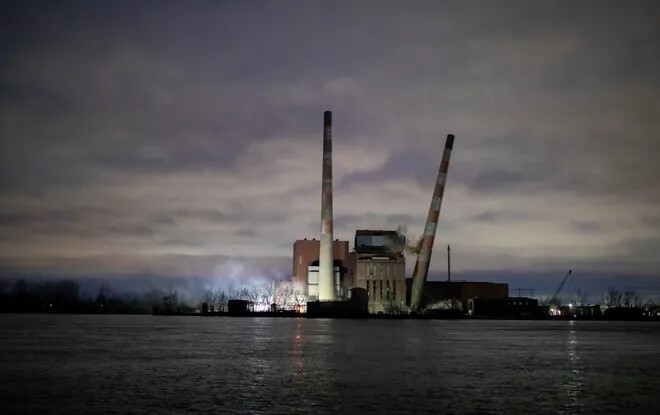
Independence Demolition (ID) was selected by DTE Energy to perform the full environmental decommissioning, demolition, and site restoration of the historic Trenton Channel Power Plant in Trenton, Michigan. Built more than a century ago along the Detroit River, the 60-acre coal-fired facility presented extraordinary technical, environmental, and logistical challenges. Aging infrastructure, legacy contaminants, proximity to protected waterways, active rail lines, and an energized utility substation required demolition precision at the highest level — all while preparing the site for future redevelopment tied to Michigan’s clean-energy transition.
Delivered within an aggressive two-year schedule, ID completed more than 400,000 work hours without a single OSHA-recordable injury. The scope included environmental remediation, hazardous material abatement, utility isolation, explosive and mechanical demolition, water treatment, foundation removal, and final site restoration. The complexity and flawless execution of the program earned ID the Industrial Project of the Year award at the 2025 World Demolition Awards.
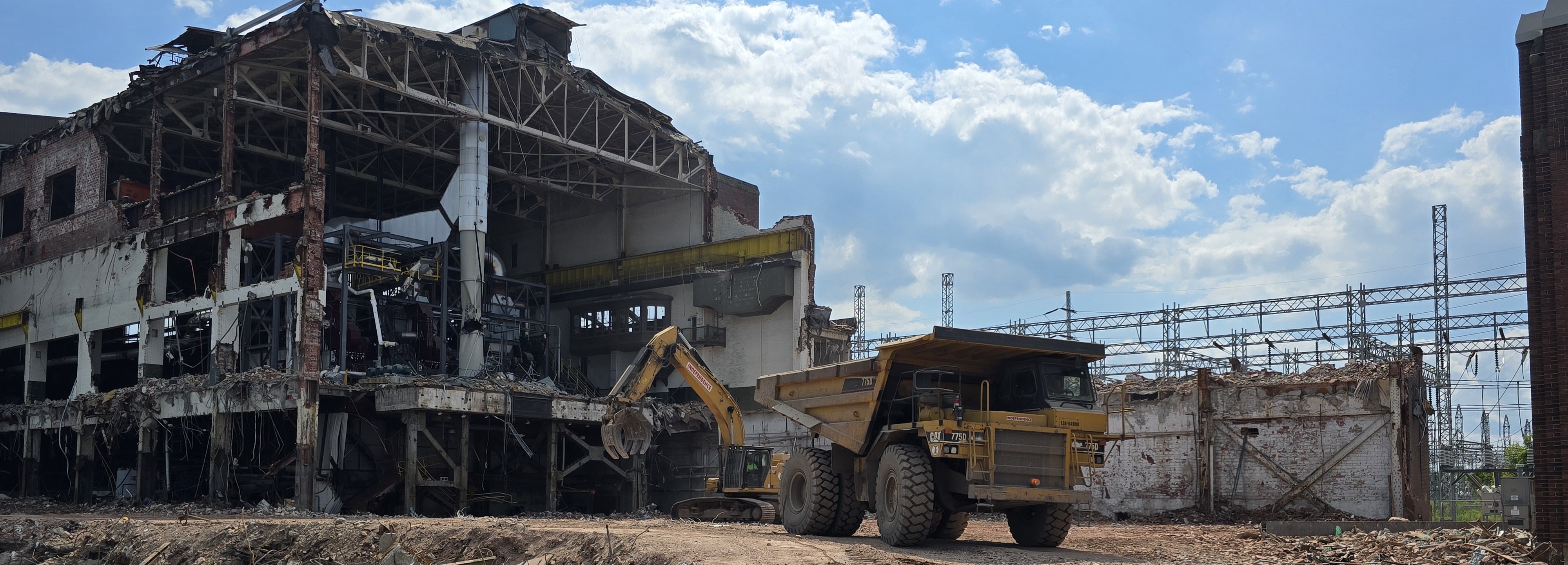
One of the project’s most critical challenges was the removal of a 650-foot turbine bay located just 25 feet from an energized 120-kV substation that remained in continuous operation throughout demolition. Any disruption posed risk to regional power distribution. To safely dismantle the structure, ID implemented surgical pre-cutting techniques, mechanical dismantling, real-time vibration monitoring, and protective shielding using conex box barricades. Every sequence was reviewed in coordination with DTE and third-party engineers, allowing the turbine bay to be removed with millimeter-level precision and zero interruption to electrical service.
Equally demanding was the explosive demolition of two 600-foot concrete stacks and massive boiler houses. The structures stood within tight spatial constraints bordered by roadways, rail corridors, and the Detroit River. ID engineered and executed two separate blast events, incorporating blast matting, exclusion zones, public notification plans, air-quality monitoring, and emergency coordination with local authorities. Both implosions were completed safely, on schedule, and without incident.
Environmental remediation formed the foundation of the project’s success. The site included asbestos-lined structures, PCB-impacted soils, a 28-acre coal yard, and settling ponds requiring dredging and dewatering. Licensed abatement crews worked alongside demolition teams under continuous air and water monitoring protocols, coordinated closely with EGLE, EPA, and local regulators. Over the life of the project, more than 340 million gallons of stormwater and process water were treated on-site to meet strict discharge standards before release to the Detroit River.
Schedule pressure added another layer of complexity. Utility isolation, abatement, demolition, and foundation removal had to progress simultaneously to meet redevelopment deadlines, including a City of Trenton requirement to remove the top ten feet of all foundations. ID deployed Lean construction planning, overlapping shifts, digital scheduling dashboards, and real-time field reporting to maintain critical path control. Additional crews and specialized drilling and blasting subcontractors accelerated heavy foundation removal while preserving schedule certainty.
Throughout execution, ID maintained an unwavering focus on safety, transparency, and stakeholder coordination. Daily toolbox talks, confined-space rescue planning, live-utility tracking, drone mapping, dust and vibration sensors, and continuous field reporting ensured complete visibility for DTE, environmental consultants, and regulatory agencies. At peak activity, teams operated around the clock, managing explosives, hazardous materials, confined spaces, and underwater work — all without a single recordable injury.
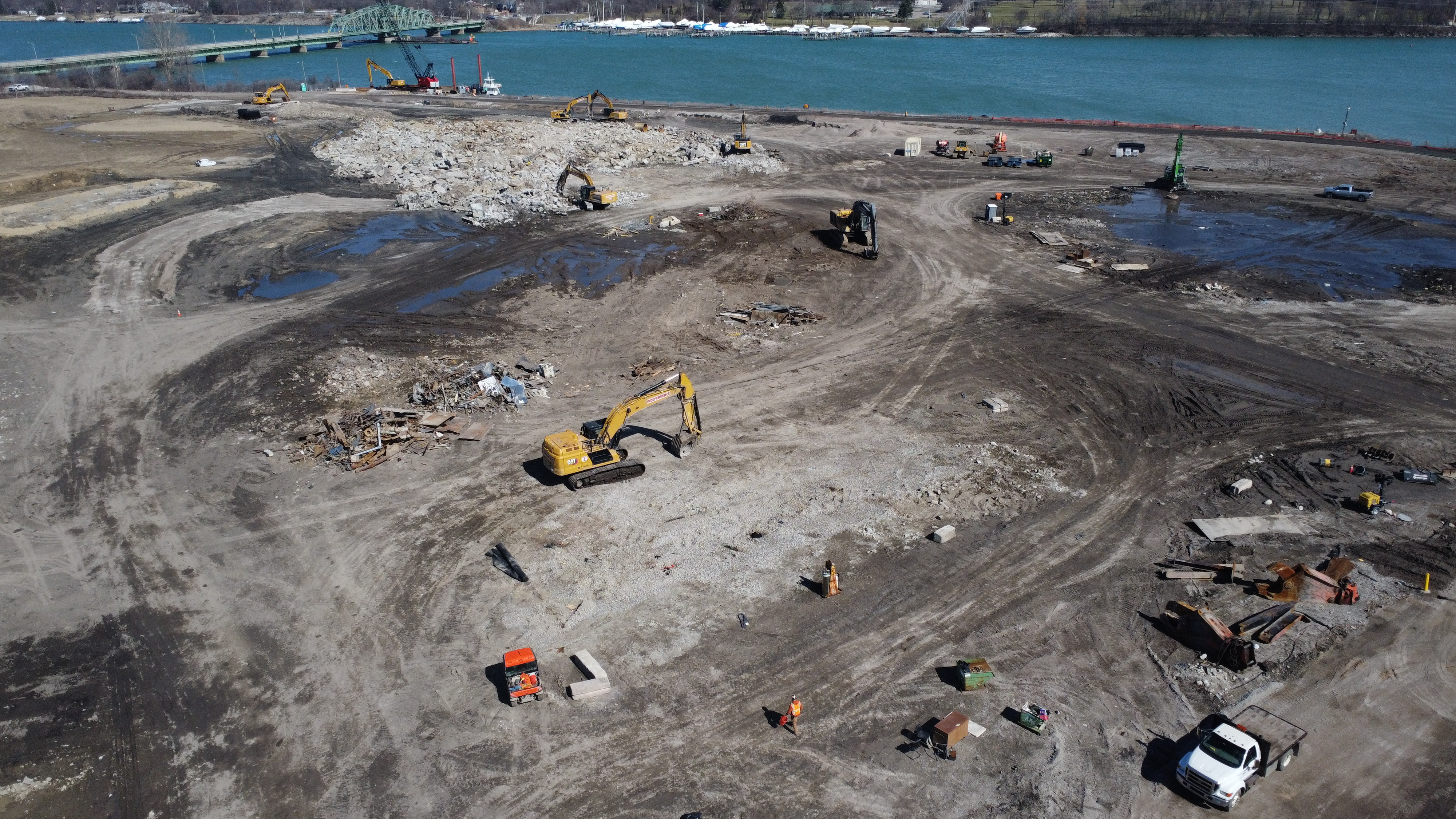
Sustainability outcomes were equally significant. ID recycled 49,000 gross tons of scrap steel, processed 100,000 cubic yards of concrete for beneficial reuse, and achieved a 98.6% diversion rate from landfill. Imported fill brought the site to final grade, completing transformation of a century-old industrial landmark into a redevelopment-ready property.
Today, the cleared Trenton Channel site is being reborn as the region’s largest battery-energy storage facility — a 220-MW / 880-MWh installation capable of powering approximately 40,000 homes. By safely removing massive industrial infrastructure beside live utilities and sensitive waterways, executing large-scale implosions without incident, and delivering exceptional environmental stewardship, Independence Demolition not only completed one of North America’s most complex demolition projects — it enabled a sustainable future for the community and the region.
Trenton, Michigan